Maryland State Government
Explore how Maryland State Government is organized and learn where to find official information that may affect Maryland notaries. This resource connects you to the role of Maryland voters, the Legislative, Executive, and Judicial branches, and the government agencies, meetings, laws, regulations, and public resources that help you stay informed and engaged.
Explore
Use the guide below to explore Maryland State Government and locate official resources relevant to Maryland notaries. Select a topic to jump directly to that section of this page.
How Maryland Government Is Organized
Voters → three branches → Principal Executive Departments
Legislative Branch
General Assembly, Senate, House Committees, DLS, and legislative resources
Executive Branch
Governor, constitutional officers, executive agencies and structure
Executive Branch:
MD Sec. of State
Special focus on the Maryland Secretary of State and the Notary Public program
Judicial Branch
Maryland Judiciary, courts and judicial resources
Principal Executive Departments
Official department directory and departments particularly relevant to notaries
Statutes
Maryland Code and resources for locating statutes
How to Read a Maryland Notary Statute
Maryland statutes can be difficult to understand if you are unfamiliar with how they are organized. The example below uses an actual Maryland notary statute to identify the different parts
Regulations & COMAR
Maryland regulations, COMAR and regulatory activity
Meetings & Public Information
Maryland General Assembly Meetings System and other ways to locate government meetings and public records/resources
Public Participation
Hearings, testimony, public comments, task forces, commissions and ways Marylanders can participate
Official Government Resources
Maryland Manuel, Maryland.gov and other authoritative source directories
YOUR VOTE COUNTS!
Tuesday, November 3, 2026
Yellow Pain's video "My Vote Don't Count" explores the perception of voter apathy and disenfranchisement within the context of government structure, shedding light on the significance of individual civic engagement. Through compelling storytelling and insightful commentary, the video prompts viewers to reconsider the impact of their votes and the role they play within the various levels of Maryland's state governance.
Yellow Pain's video "My Vote Don't Count" explores the perception of voter apathy and disenfranchisement within the context of government structure, shedding light on the significance of individual civic engagement. Through compelling storytelling and insightful commentary, the video prompts viewers to reconsider the impact of their votes and the role they play within the various levels of Maryland's state governance.
How Maryland State Government Is Organized
Start with Maryland's voters, then explore the three branches of State government and the official resources available for each.
Source: Maryland State Archives, Maryland Manual On-Line — Maryland Government Organizational Chart.
Explore Maryland's Legislative Branch
Follow the structure of the Maryland General Assembly and use the links below to explore its chambers, committees, task forces, commissions, workgroups, and legislative research resources.
Maryland Executive Branch
Explore Maryland's Executive Branch, including its leadership, offices, departments, agencies, and commissions, with a special focus on the Maryland Secretary of State and the Notary Public program. MDNIA is emphasizing the Maryland Secretary of State because it is the executive office most directly connected to Maryland notaries.

Maryland Governor Wes Moore

Maryland Lieutenant Governor Aruna Miller
Explore Maryland's Executive Branch
Explore the leadership, constitutional offices, departments, agencies, and other governmental bodies that carry out and administer Maryland law and State government operations.
Attorney General
The Attorney General serves as Maryland's chief legal officer and provides legal counsel to State government.
EXPLORE ATTORNEY GENERAL ↗Comptroller of Maryland
Explore the office responsible for administering Maryland's tax laws and overseeing important State fiscal functions.
EXPLORE THE COMPTROLLER ↗State Treasurer
Explore the office responsible for State treasury management, banking, investments, debt, and other financial responsibilities.
EXPLORE THE TREASURER ↗Secretary of State
Explore the office responsible for State commissions, executive records, charitable organizations, and Maryland's notary public program.
EXPLORE SECRETARY OF STATE ↗Adjutant General
Learn about the State official responsible for leadership and administration of Maryland's Military Department and National Guard.
EXPLORE THE ADJUTANT GENERAL ↗Governor's Executive Council
Explore the Governor's Cabinet, which coordinates, directs, and supervises the Executive Branch of Maryland State government.
EXPLORE THE CABINET ↗Maryland Secretary of State

Susan Lee
Administration & Support, Charities & Legal, Safety & Support Services & Division of State Document
The Maryland Secretary of State, who is appointed by the Governor, serves as the chief elections officer, oversees business registrations, and maintains official records of state government actions. Additionally, the Secretary of State is responsible for administering notary public commissions and authenticating public documents.
A Closer Look for Maryland Notaries
The Office of the Maryland Secretary of State has responsibilities extending well beyond the notary public program. The official organizational chart provided above shows the broader structure, divisions, programs, and responsibilities under the Secretary of State. The interactive guide below highlights selected areas of the office that are especially relevant to Maryland notaries, including Notaries Public, Certifications, COMAR, and the Maryland Register.
Secretary of State Resources for Maryland Notaries
Explore selected areas of the Maryland Secretary of State that are especially relevant to Maryland notaries and notarial practice.
Explore Maryland's Judicial Branch
Explore Maryland's court system and use the official resources below to learn about the appellate courts, trial courts, specialized probate courts, court locations, and the administration of the Maryland Judiciary.
Explore Maryland's Principal Executive Departments
Maryland's Executive Branch includes 23 principal departments. Explore each department to learn about its responsibilities, agencies, organizational structure, leadership, reports, and role in Maryland State government.
Statutes
Explore Maryland statutes, learn where to find the law, and access the State Government Article and statutory provisions governing Maryland notaries public.
Why Do the Code of Maryland and State Government Article Links Look the Same?
The State Government Article is part of the Code of Maryland. Both resources use the Maryland General Assembly's Statutes page. To explore the State Government Article, select “State Government” from the Articles menu. Maryland notary statutes are located within that Article under Title 18.
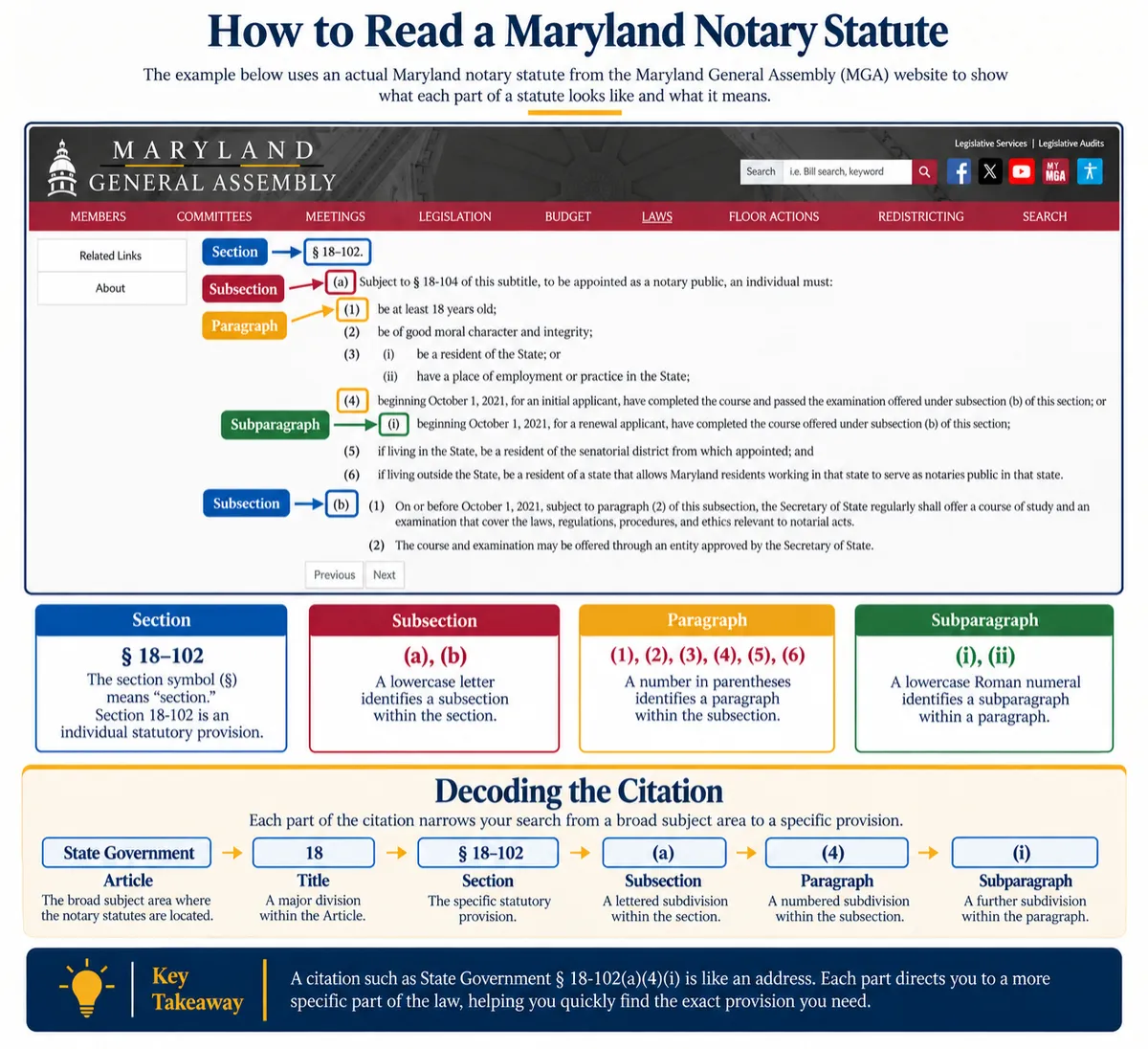
How to Read a Maryland Notary Statute
Maryland statutes can look complicated when you first see the letters, numbers, symbols, and subdivisions. Understanding how the Maryland Code is organized can make it easier to locate and read the specific law you need.
See It in an Actual Maryland Notary Statute
The example below uses Maryland State Government § 18-102 to show how a section is divided into smaller parts and how a statutory citation directs you to a specific provision.
Regulations & COMAR
Follow Maryland's regulatory process, review proposed and final regulatory actions, and research the regulations currently published in the Code of Maryland Regulations.
For Maryland Notaries: Proposed regulations can change the rules governing notarial practice before those changes become final. Maryland notaries can use the Table of Pending Proposals to identify proposed regulatory changes and follow them through the rulemaking process. There are currently no pending proposals specifically affecting Maryland notary regulations. Last verified: October 17, 2026
Meetings & Public Information
Find public meetings, understand Maryland's open meeting requirements, and learn where to access or request government information and public records.
Follow Maryland Government Activity
Public meetings and government records can provide important information about decisions, discussions, proposals, and actions that may affect Maryland notaries and the public.
Find Public Meetings
Maryland General Assembly Meetings
Search scheduled hearings and public meetings, including legislative committees, task forces, commissions, workgroups, and other bodies appearing in the General Assembly's Meetings System.
Understand Open Meetings
Maryland Open Meetings Act
Learn about Maryland's requirements for public bodies to conduct public business openly, provide notice of meetings, and make certain meeting information available to the public.
Request Public Records
Maryland Public Information Act
Learn how Maryland's Public Information Act provides a process for requesting access to government records, including the procedures, exceptions, copies, and fees that may apply.
Remember: Public information may be available through different government websites and systems. A meeting, notice, agenda, report, or other government record may be public even when it is not prominently publicized in the place you first think to look.
Public Participation
Finding government activity is only the first step. Learn how members of the public can follow issues, communicate their views, provide testimony, and participate when opportunities for public input are available.
Your Voice Matters Before the Decision Is Made
Maryland residents can participate in government in several ways. The opportunity and procedure depend on whether the issue involves legislation, regulations, a public meeting, or direct communication with government officials.
Participate in Legislative Hearings
Follow bills that matter to you and learn how to provide oral or written testimony when Maryland General Assembly committees hold public bill hearings.
Comment on Proposed Regulations
Review proposed regulations published through the Maryland Register and look for the public comment instructions, deadlines, hearings, and agency contact information provided with a proposal.
Attend & Observe Public Meetings
Attend open meetings to observe government deliberations and decision-making. If a public body offers a public comment period, follow that body's procedures for participating.
Contact Your Legislators
Find the Maryland legislators who represent your district and contact them directly to share information, concerns, questions, or your position on legislation and public policy.
Know the difference: The right to attend an open public meeting does not automatically include the right to speak during that meeting. Public testimony, public comment periods, and other participation opportunities may have separate procedures, registration requirements, and deadlines. Always review the instructions for the specific hearing, meeting, or regulatory action you want to participate in.
Official Government Resources
Go directly to official Maryland government sources to research State government, legislation, courts, notary information, statutes, regulations, and regulatory activity.
Go to the Source
When researching Maryland law, government activity, or notarial requirements, use official government sources whenever possible. These resources can help you verify information directly.
Maryland Manual On-Line
Explore Maryland's government structure, constitutional offices, departments, independent agencies, commissions, task forces, officials, organizational charts, reports, and other State government information.
Maryland General Assembly
Research legislation, statutes, legislators, committees, hearings, votes, legislative sessions, meeting information, and other activity of Maryland's Legislative Branch.
Maryland Judiciary
Access Maryland court information, court locations, forms, opinions, rules, administrative orders, schedules, and other resources from the Judicial Branch.
Maryland Notary Public
Access official Maryland Secretary of State information for Maryland notaries, including commissioning information, requirements, forms, guidance, and notary resources.
COMAR
Search the Code of Maryland Regulations to locate administrative regulations issued by Maryland State agencies, including regulations relevant to notarial practice.
Maryland Register
Follow proposed regulations, final actions, emergency actions, notices, hearings, and other regulatory activity published by Maryland's Division of State Documents.
Go to the source. Maryland Notaries In Action can help make government information easier to find and understand, but official Maryland government sources should be used to verify current laws, regulations, requirements, notices, and government activity.
Subscribe
Subscribe
Sign up to receive the most up-to-date information Maryland Notaries In Action has to offer.


Maryland Notaries In Action
6200 Baltimore Ave. Ste 300-1011
Riverdale, MD 20737
Copyright © 2026 Maryland Notaries
In Action - All Rights Reserved.